
The REEDS program · skill 4 of 5
Discover. Stay curious and try new things.
The tools will keep changing. The people who do well are the ones who keep trying things. Discover is the skill of staying curious, building on ideas, and running small experiments.
Book an intro call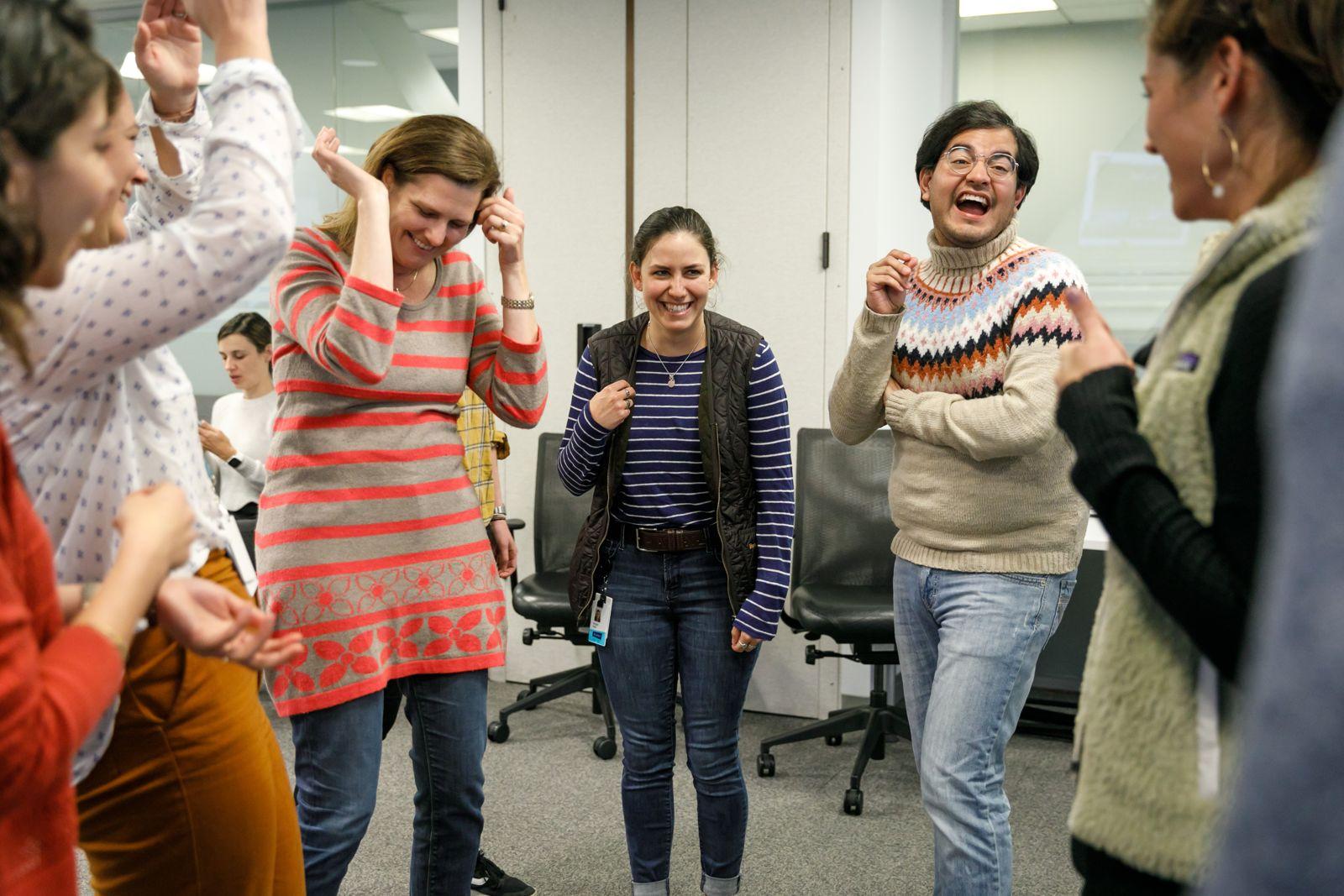
What Discover means.
Discover is about curiosity and creativity. It covers how you ask better questions, how you build on other people’s ideas, and how you test something new without betting everything on it.
It draws on the group of capabilities MIT Sloan researchers describe as creativity and imagination. They name improvisation and curiosity in their framework.
This is where Oak & Reeds started. We were founded to bring the tools of improv into the workplace. "Yes And" is the improv habit of accepting an idea and adding to it, and it is a practical way to get more out of a team and out of AI.
Why Discover matters more now.
Nobody has a finished playbook for working with AI. Teams learn by trying. Here is what the research says.
AI can lift each idea and narrow the range.
In an experiment with 293 writers, access to AI ideas made individual stories rate as more creative. The stories also became more similar to each other. The task was short story writing, not workplace teamwork.
Source: Generative AI enhances individual creativity but reduces the collective diversity of novel content (opens in a new tab). Doshi and Hauser, Science Advances, 2024.
Groups need someone to widen the options.
BCG’s account of its experiment with consultants reported that relying on the AI tool’s output could reduce a group’s diversity of thought by 41%.
Source: How People Can Create, and Destroy, Value with Generative AI (opens in a new tab). BCG Henderson Institute, 2023.
AI is changing how teams work, so teams have to experiment.
In a randomized study of 776 professionals at Procter & Gamble, individuals with AI matched the performance of teams without it, and people using AI produced balanced solutions regardless of their professional background.
Source: The Cybernetic Teammate (opens in a new tab). Dell’Acqua and colleagues, NBER working paper, 2025.
What Discover looks like at work.
Discover looks like a team that treats "I do not know yet" as a starting point.
A brainstorm that builds
Instead of shooting down the first idea, the group adds to it. Ten minutes later they have something none of them walked in with.
A better question
Someone gets a flat answer from an AI tool. Rather than give up, they get curious about what they left out, and ask again.
A small test
A leader wants to change a process. They try it with one team for two weeks and agree up front what they will look at.
Discover at every level.
People learn a different side of Discover as they take on more responsibility. One topic per session.
Core · lead yourself
Curiosity
People practice asking better questions, of colleagues and of AI, and staying open when the first answer falls flat.
The Core level →Manager · lead a team
Brainstorming and Yes And
Managers learn to run brainstorms that build on ideas, using the improv practice of Yes And.
The Manager level →Executive · lead the organization
Experimentation
Senior leaders learn to make room for small experiments, and to treat what does not work as information.
The Executive level →
Curious what REEDS could look like for your team? Let's talk.
Book an intro call
A 30 minute call with Dave Collinsof Oak & Reeds Interactive Training
Not ready to book yet?
Leave a note and Dave will reply to you himself.